In today’s B2B environment, speed, stability, and quality control are key factors of competitiveness. That is why more and more companies choose suppliers with a full production cycle. But what does this mean in practice, and why is it truly beneficial?
In this article, we will explore how a full cycle — from raw material import to finished packaging production — affects pricing, quality, lead times, and flexibility in cooperation
What Is a Full Production Cycle?
A full production cycle is a business model in which all stages of product creation are performed within a single company without involving external contractors.
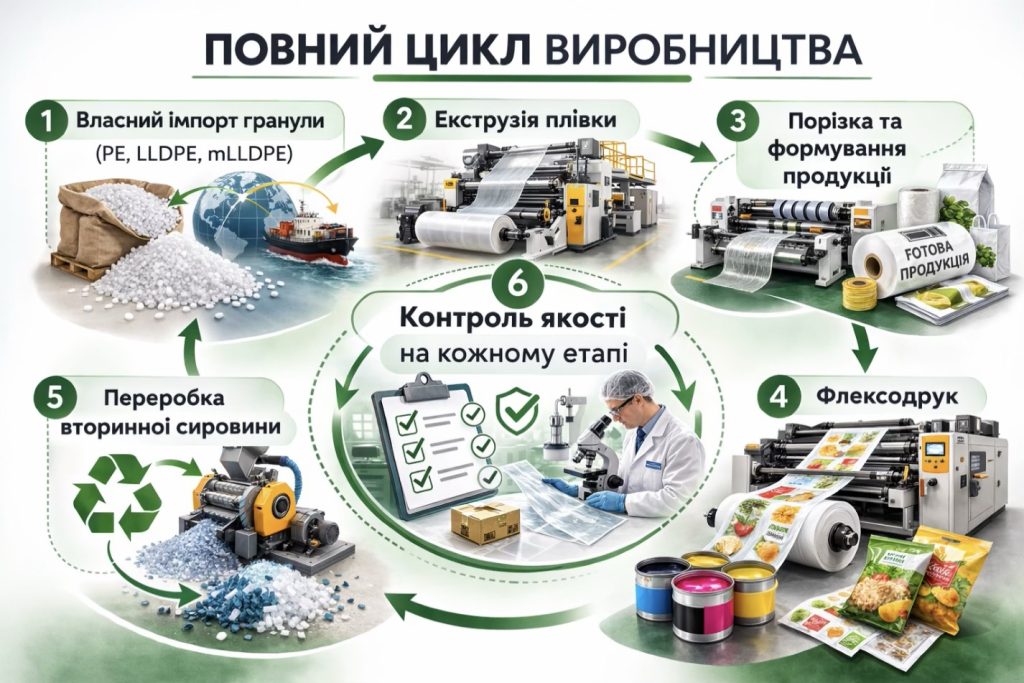
In the polymer packaging industry, this includes:
- in-house raw material import
- film extrusion
- cutting and product forming
- flexographic printing
- recycling of secondary raw materials
- quality control at every stage
This approach differs significantly from a model where a company only resells products or outsources parts of the process to third-party manufacturers.
1. Quality Control at Every Stage
When the entire production process is concentrated within one company, it allows control over:
- raw material quality
- extrusion parameters
- film thickness
- ink adhesion
- packaging strength and sealing properties
This is especially important for B2B clients, where unstable material quality can lead to production line downtime or product claims.
A full production cycle minimizes risks such as:
- batch inconsistencies
- color variations
- unstable density
- weight deviations
2. Competitive Pricing Without Intermediaries
When a company manages its own raw material imports and production facilities, it:
- avoids paying intermediary margins
- does not depend on contractor markups
- can flexibly manage pricing
This becomes particularly important for large volumes or long-term contracts.
A full cycle allows optimization of:
- logistics
- warehouse inventory
- polymer granule procurement prices
- recycling costs
As a result, the client receives competitive pricing with stable quality.
3. Stability of Supply and Lead Times
Working with external contractors always involves risks such as:
- logistics disruptions
- production delays due to overloaded facilities
- long approval cycles between the customer and the contractor
With a full production cycle, the company independently manages raw material stocks, production schedules, and order priorities.
If printing, extrusion, and cutting are located in the same facility, coordination takes hours instead of weeks.
4. Environmental Responsibility
A full production cycle makes it possible to:
- recycle production waste
- reuse secondary raw materials
- reduce plastic consumption
- optimize film thickness without compromising strength
This is not just a trend but also a real resource-saving strategy.
Today, eco-friendly packaging is becoming a competitive advantage in the B2B market.
5. Transparency and Responsibility
When all processes take place within one company:
- it is easier to identify the causes of deviations
- issues are resolved faster
- quality standards are easier to implement
The client receives one responsible partner, not a chain of suppliers.
Conclusion
If stability, predictability, and quality are important for your business, a full production cycle becomes a strategic advantage.
A full production cycle is not just a production model. It is:
- control
- cost efficiency
- flexibility
- stability
- long-term partnership
By choosing a manufacturer with a full production cycle, a business receives not just packaging but a systemic solution designed for long-term performance.
Need a Consultation?
If you are looking for a full-cycle packaging manufacturer, it is important to evaluate not only price but also technological capabilities, laboratory facilities, experience, and supply stability.
We can help you:
- analyze your current packaging
- calculate cost efficiency
- propose the optimal film structure
- develop a customized packaging solution.